


How to Choose a Vibrator Motor: 2, 4, 6 or 8 Poles?

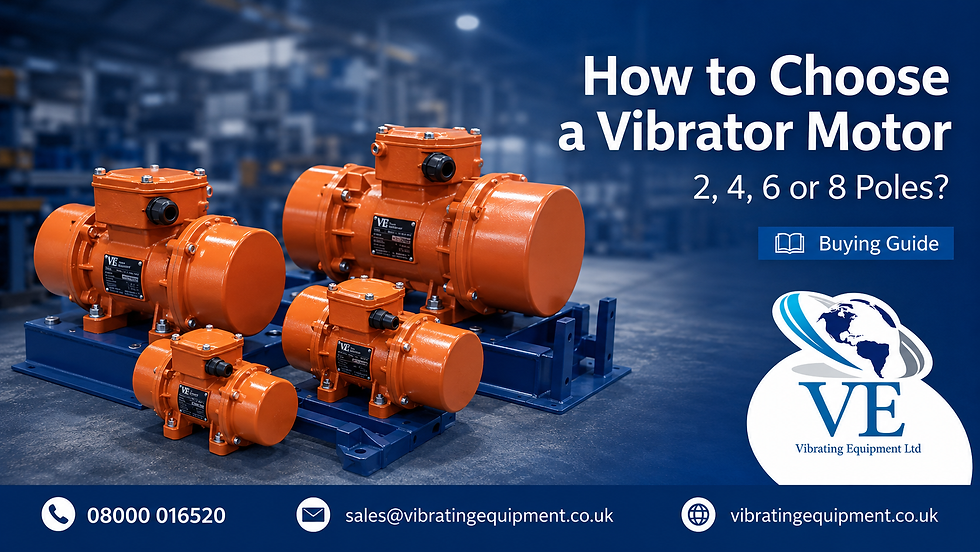
The number of poles is one of the first details shown when purchasing an industrial vibrator motor.
However, pole count does not simply indicate whether one motor is more powerful than another. It primarily affects operating speed and vibration frequency.
The correct motor must be selected by considering pole count together with centrifugal force, machine mass, material load, mounting position, required movement and electrical supply.
OLI’s MVE standard motor range includes 2, 4, 6 and 8 pole models for vibrating feeders, screens, conveyors, compaction tables and spiral elevators.
What does motor pole count mean?
The number of poles relates to the magnetic field created inside the motor.
At a fixed electrical frequency, a motor with fewer poles has a higher synchronous speed. A motor with more poles operates more slowly.
The theoretical synchronous speed is calculated from the electrical frequency and number of poles.
At 50 Hz, the theoretical speeds are:
Pole configuration | Theoretical synchronous speed |
2 poles | 3,000 revolutions per minute |
4 poles | 1,500 revolutions per minute |
6 poles | 1,000 revolutions per minute |
8 poles | 750 revolutions per minute |
An induction motor normally runs slightly below its theoretical synchronous speed because of slip. The precise operating speed should therefore be taken from the manufacturer’s technical data or motor nameplate.
Why speed matters on vibrating equipment
A vibrator motor contains adjustable eccentric weights mounted on its shaft.
As the shaft rotates, these weights generate centrifugal force. The rotating speed influences the vibration frequency and the force created by the eccentric mass.
Increasing speed does not simply make the machine move further. It changes the complete dynamic behaviour of the machine.
The resulting movement depends on:
Motor speed
Eccentric weight setting
Motor centrifugal force
Machine mass
Product load
Spring stiffness
Structural rigidity
Motor mounting angle
Number and arrangement of motors
This is why a 2 pole motor should not automatically be described as stronger than a 6 pole or 8 pole motor.
Each motor range is designed to provide a particular force at its intended speed.
When is a 2 pole vibrator motor used?
A 2 pole motor provides the highest vibration frequency of the four common configurations.
At 50 Hz, its theoretical synchronous speed is 3,000 revolutions per minute.
A 2 pole motor may be considered where fast, relatively fine vibration is required. Typical applications can include:
Hopper and chute flow assistance
Smaller vibrating feeders
Certain compacting applications
Small screens or sieves
Filter cleaning systems
Equipment requiring high frequency vibration
The final suitability still depends on the machine structure and required vibration movement.
High speed vibration can also create significant dynamic forces. The mounting plate, fixings and surrounding structure must be suitable for the selected motor.
When is a 4 pole vibrator motor used?
A 4 pole motor has a theoretical synchronous speed of 1,500 revolutions per minute at 50 Hz.
It is widely used across general industrial vibrating machinery and may be considered for:
Vibrating feeders
Vibrating screens
Vibrating conveyors
Compaction tables
Hopper discharge systems
Dewatering equipment
Medium duty process machinery
A 4 pole motor offers a useful middle ground between vibration frequency and achievable machine movement.
However, it is not a universal choice. A machine requiring slower, longer movement may perform better with a 6 pole or 8 pole arrangement.
When is a 6 pole vibrator motor used?
A 6 pole motor has a theoretical synchronous speed of 1,000 revolutions per minute at 50 Hz.
The lower frequency can be suitable where the machine requires slower movement or a longer stroke.
Possible applications include:
Larger vibrating feeders
Heavy duty screens
Vibratory spiral elevators
Gentle product conveying
Larger compaction systems
Equipment handling heavier material loads
Slower movement can be useful when products must travel in a more controlled manner or when a larger machine requires a different dynamic response.
The machine must still be designed for the chosen operating speed. Simply replacing a 4 pole motor with a 6 pole motor will not necessarily improve performance.
When is an 8 pole vibrator motor used?
An 8 pole motor has a theoretical synchronous speed of 750 revolutions per minute at 50 Hz.
It is generally considered for slower vibration duties and specialised machinery where lower frequency movement is required.
Possible applications can include:
Heavy vibrating screens
Large compaction tables
Gentle handling systems
Large vibratory conveyors
Special process machinery
Equipment requiring relatively slow, deliberate movement
An 8 pole motor is not automatically suitable for every heavy machine. The motor force, spring arrangement and machine mass must be calculated as part of the complete system.
Pole count does not determine centrifugal force
Two motors with the same pole count can produce very different centrifugal forces.
Likewise, two motors with similar force ratings but different pole counts can produce different machine behaviour.
When selecting a motor, check:
Maximum centrifugal force
Adjustable force range
Working moment or eccentric moment
Rated speed
Motor mass
Mounting dimensions
Electrical current
Starting current
Duty rating
Operating temperature limits
The OLI MVE range is available across a wide range of adjustable centrifugal force ratings, so the complete technical data should be reviewed rather than selecting by pole count alone.
Single motor and twin motor arrangements
The number of motors also affects the machine’s movement.
Single vibrator motor
A single unbalanced motor creates a rotating force.
Depending on its mounting position and the machine design, this may produce circular, elliptical or multidirectional movement.
Single motor arrangements are often used on smaller machines, hoppers, circular sieves and certain compacting applications.
Two counter rotating motors
Two correctly matched motors can be mounted so that they rotate in opposite directions.
The transverse force components oppose each other, while the force components along the intended direction combine. This produces a substantially linear vibration.
Twin motor arrangements are commonly used on:
Linear vibrating feeders
Rectangular screens
Vibrating conveyors
Compaction tables
Dewatering screens
Larger material handling equipment
Both motors must match in model, speed, force setting and electrical characteristics.
Information needed to select a vibrator motor
A responsible motor selection should be based on the complete machine.
Provide the following information where possible:
Machine mass
Include the moving section of the machine, not the stationary support frame.
Maximum material load
Include the greatest amount of product expected on the machine during normal or abnormal operation.
Existing motor details
For replacements, provide a clear photograph of the full nameplate and record:
Manufacturer
Model number
Pole count
Voltage
Frequency
Phase
Current
Centrifugal force
Rotational speed
Mounting dimensions
Required machine movement
Describe whether the machine feeds, conveys, screens, compacts, discharges or elevates material.
Number of motors
Confirm whether the machine uses one motor or a matched pair.
Electrical supply
Specify voltage, frequency, phase and available control equipment.
Environment
Identify water, dust, chemicals, food contact requirements, high temperatures, low temperatures and any hazardous area classification.
Duty cycle
Confirm whether the motor runs continuously or intermittently and state the expected hours per day.
Replacing a motor on a twin motor machine
When two motors operate as a matched pair, fitting one motor with different characteristics can create uneven vibration.
The replacement should match:
Pole count
Centrifugal force
Rated speed
Voltage and frequency
Frame and mounting pattern
Eccentric weight setting
Direction of rotation
Electrical current and connection
Where one motor has failed after substantial operating time, the condition of the second motor should also be assessed.
Vibrating Equipment Ltd recommends replacing both motors in certain paired configurations to preserve balance and avoid uneven wear.
Can a variable frequency drive control a vibrator motor?
Some vibrator motors are suitable for use with a variable frequency drive, provided the motor manufacturer’s operating limits and installation instructions are followed.
Changing frequency changes motor speed. Because vibration force is strongly influenced by rotational speed, reducing frequency can substantially alter machine performance.
A variable frequency drive must not be treated as a substitute for correct motor sizing.
Check:
Permitted frequency range
Motor cooling requirements
Maximum current
Starting and stopping ramp
Cable specification
Electromagnetic compatibility
Thermal protection
Behaviour of paired motors
OLI states that its standard MVE range is suitable for inverter use, subject to the applicable product data and technical requirements.
Common vibrator motor selection mistakes
Selecting by physical size
Two motors with a similar housing size may have different force, speed, voltage or mounting characteristics.
Selecting by centrifugal force alone
The same force at a different frequency can create completely different machine behaviour.
Fitting different motors as a pair
Paired motors should have matching dynamic and electrical characteristics.
Ignoring the weight setting
The eccentric weights must be adjusted correctly and equally at both ends of the motor.
Changing pole count without reviewing the machine
Changing from 4 poles to 6 poles, for example, changes the vibration frequency and may reduce or alter material movement.
Ignoring the support structure
A powerful motor fitted to an inadequate mounting plate can cause cracking, loosening or premature bearing failure.
Using an unsuitable electrical supply
Voltage, frequency and motor connection must match the nameplate and technical documentation.
Frequently asked questions
Is a 2 pole vibrator motor more powerful than a 4 pole motor?
Not necessarily. A 2 pole motor operates at a higher speed, but motor power and centrifugal force depend on the individual model. Pole count describes speed characteristics rather than overall strength.
Can I replace a 4 pole motor with a 6 pole motor?
Not without reviewing the machine. The lower speed will change vibration frequency, centrifugal force and material movement.
Do paired motors need to rotate in opposite directions?
On a typical linear vibrating machine, the motors are arranged to counter rotate. The correct direction must follow the machine and motor manufacturer’s instructions.
Can the centrifugal force be adjusted?
Many industrial vibrator motors have adjustable eccentric weights. Adjustments must be made equally and in accordance with the manufacturer’s procedure.
Which motor is best for a vibrating feeder?
There is no single answer. Selection depends on feeder mass, material load, required feed rate, trough size, spring system and desired movement.
Contact Vibrating Equipment Ltd
Vibrating Equipment Ltd supplies industrial vibrator motors for feeders, screens, conveyors, compaction tables, hoppers and bespoke vibrating machinery.
For replacement motor assistance, send a clear photograph of the complete nameplate together with details of the machine and electrical supply.
Telephone: 0800 001 6520
Comments